Tuesday, August 6, 2013

Entrepreneur: Living the Dream?

            Is being an entrepreneur all it’s cracked up to be? First off who wouldn’t want to be their own boss, make the big decisions, have people work for you, and be able to keep all the profits. So you start out with a great idea and develop a business plan. Next you spend a few weeks finding investors but it is well worth the time. Now the fun begins and you pick out an office building, hire some employees, and start making products or provide services. You know it is slow now but a few years go by and now you are really making good money. You take a vacation and upgrade your lifestyle now that you have made it. The business is basically running itself and life is good. You plan to just manage this business or maybe start a few other businesses. Life is great and everyone loves you.

The above is a sweet dream of what is taught in business school or is a fairytale told by business professionals who have never started a business from scratch. The reality is you struggle to find capital and then once you have it you find out that it wasn’t enough. The reality is that business school and work experience teach people of the entrepreneur fairytale. If you haven’t actually started a business on your own and by business I mean a corporation, not some mom and pop shop. Here is a list of what real entrepreneurs will experience…
1.      Hiding from debt collectors.
2.      Hiding from lawyers delivering papers.
3.      Going to court for debt collection or business issues.
4.      Going for months and even years without a paycheck.
5.      Having to explain why the investors’ money is all gone.
6.      Depression as you realize there is no way out.
7.      Stress and anxiety from…
a.       Daily business
b.      IRS
c.       Employee problems
d.      Trying to save your life savings
e.       Having no personal income
f.       And basically anything that can go wrong goes wrong
8.      Begging hundreds of people for money to start a business or to fund a dying business.
9.      Firing employees and dealing with employee issues.
10.  Personal relationships being destroyed

I have experienced all the above and I am just a core employee of a start-up company. Having family involved increases the stakes especially when it is a real business with a group of investors. I have worked for over seven years and have had periods where I had no income from a few months to two years and even picked up a second job all while attending college. The family aspect makes relationships tough as every day and every minute you are thinking or discussing the business. All of that being said it has been the best experience I could have ever had. I have professional experience far before most people my age, I have learned tough life lessons, and I understand business from the ground up. I have been paid next to nothing but I knew the risk when I started and if it makes it I am sure management and the investors will help to reward the hard work. Overall being an entrepreneur is far different from what is taught and the risks are extremely high. A true entrepreneur has skills that can only be learned and understood from the desperation of being an entrepreneur.

Thursday, June 27, 2013

Economic Pet Peeves


My biggest pet peeve in economics is The Wealth of Nations by Adam Smith and specifically the “Invisible Hand” theory. I live by The Wealth of Nations but economists are driving me nuts.

To start with The Wealth of Nations which I am betting it is by far the most quoted book/literature in economics and is not even read by the vast majority of economists. By read I mean cover to cover not I skimmed it or I just read one of the five “books”. I have been reading the book for years now and it has taken me years due to the vast amount of pages, the depth of the concepts, and the lack of my personal free time. I have been told by PhD students, Professors, students, and economists that The Wealth of Nations is a good book which I agree with but then they miss quote portions of it just to prove a point. You can’t just take a sentence out of the book with no context and then think somehow this proves your point. I view it as the bible of economics and that being said it has been miss quoted just as much as the Bible. If you haven’t read the book, please don’t quote it and then think you have made a point. The book is written in Old English (published in 1776) which again adds to the complexity of understanding the material.

For the modern economist who thinks that the economy is like a house cat you must not understand Adam Smith or you don’t believe in the foundation that Adam Smith has created. If you don’t believe in Adam Smith’s principles please state that before you speak and announce that you are an economist as if it validates you. If I know you don’t agree with Adam Smith than at least I can understand that you have a different train of thought which I can respect. Now back to the house cat; modern economists think that the economy is like a feral cat that has been domesticated by their fancy econometrics. The Invisible Hand theory states that the economy allocates assets (being money, labor, or anything of value) the most efficient way possible. Now you have the modern economist who steps in and decides that having lower GDP is bad, poverty is a problem we must solve, and the list goes on with issues that economists feel they can solve with econometrics. The economists use econometrics to look for patterns in market data and then figure out how to adjust a variable to coerce people and the economy to adjust in a way that will “fix” their cause. The problem I have is that the economy is a wild beast that can’t and shouldn’t be tamed. Somehow the economists think they are God and think they know better than the Invisible Hand which is the economy. No human can ever out do the markets and no human should try to interfere with the markets to push their cause.

An example of the feral cat is the long list of financial crisis we continue to have and will continue to have. The economists on their ivory towers dictate governmental policy to help push their causes and agendas. Then when the cat attacks them they act surprised and can’t understand why the cat that they thought they tamed attacked. After these crisis (typically financial) the economists all get together and brainstorm why it happened. They then write books on these crisis and give ways on how next time they will tame the economy using new and better methods. Why can’t economists realize that the economy has allocated assets due to the efficient equilibrium? Every time you push it in the direction you want it fights back and makes a market correction. The Invisible Hand principle that the modern economists say they believe is being contradicted every time they try to manipulate the economy. The modern economist is ignorant if he claims to believe in the Invisible Hand and then manipulates the markets in an attempt to please the public.

In conclusion, if you are going to preach economics and use The Wealth of Nations make sure you understand what you are talking about before you preach it. If you ask me a question and I don’t know, I will either tell you I don’t know or I will voice it as it is my opinion. Just be honest!

Wednesday, June 5, 2013

Market Interpretation: June 2013

    Over the past six months the market has been rising and I have read a lot of article on why people think this is happening. Some analyst think this is an over reaction to good news and that the market is going to take a big hit soon as a corrective measure. As a note, today the market is down about 0.80%. This view of how the market is over valued is completely wrong for many reason.

    Analyst are looking at market GDP as an indicator of the stock market which is very flawed. This flaw is due to the Keynesian thought process which is wrong in more ways than I would like to talk about in this post. The reason the market took a hit today is because the market didn't add as many jobs in the private sector as the analyst predicted (http://www.latimes.com/business/money/la-fi-mo-adp-jobs-economy-20130605,0,2964130.story). This argument of unemployment is why some analyst have been predicting that markets have over reacted to good news and that the markets will correct downward. The problem is these analyst haven't been looking at corporations at a micro level and then figuring out how this effects the market and the economy.

    The real reason that the market has had an upward trend is due to increased productivity. Increased productivity leads to an increase in GDP and many other measures but it is important to note that productivity is far more important than GDP. Since the credit crisis many people were laid off meaning that unemployment has gone up. These companies first took a hit since people didn't have money to spend. As the market started to recover and many Americans started to increase spending regardless of employment due to the stimulus and social programs. These companies started to streamline their processes and got more efficient since they had fewer employees and an increase in output. Basically these companies have learned to run their business with less employees which has led to an increase in productivity. Productivity meaning that the ratio of employees to units produced as decreased.

    This increase in productivity has led to the need for less employees which means unemployment rates will remain high. The unemployment rates will change once the demand for goods and services grows enough to employee these people or until companies get lazy again and become more inefficient. The bottom line is that companies are reducing costs in comparison with revenue which is leading to higher returns on their stock. Since many companies are experiencing this trend it is making the market or at least the indexes such as the S&P 500 increase as a whole. The market will fluctuate over time but the long-run (the next 1-2 years) will have good returns unless more manipulation on behalf of the government we currently have forces companies to make inefficient decisions.

    As a side note many people are predicting another market crisis in the next 5 to 10 years which I would agree with as long as the government and Keynesian ideas continue to dominate. This upcoming crash will be due to poor policy and over regulation which has been the causes of most if not all of our financial crisis.

Sunday, June 2, 2013

The Psychology Behind Student Debt


            Student debt is a growing concern among Americans as we have now pasted a trillion dollars nation-wide. Student debt isn’t always needed and higher education is not always worth the cost but I will cover higher education issues in another post. The issue at hand is how to make smart decisions on how to repay the loans. The one decision that I would like to cover is investing.

            I have heard from many people including financial planners who recommend making investments as a way to save for one’s retirement. I agree that retirement is an important goal to look towards but there is a psychological pitfall by investing while having student debt. Many people feel that investing now will make you millions of dollars and that is far more than your student loans. This is wrong.

            Students should be looking at the returns not the total “expected" amount. A Federal Stafford loan has an interest rate of 6.8% and a Federal Graduate Plus loan has a rate of 7.9%. There are also Federal Perkin loans which have a 5% interest rate and private loans which can have lower rates as long as you have good credit. Private loans offer little or no repayment options. Most students will have a rate between 6.8% - 7.9%. Now it is crucial to understand that debt (loans) are the same as an inverse investment since you will have cash outflows instead of expected cash inflows. For comparison, a 10 year bond (the same maturity as a Federal student loan) today is yielding 2.14% (risk-free rate). The average stock return is about 8% over the long-run.

            Now you can clearly see that borrowing money at any of the rates above and receiving returns at the risk-free rate yields a negative return (2.14 – 6.8 = -4.66%). Now there is the option of investing in stocks with the assumption that you will get 8%. The 8% however is risky and the additional 5.86% is compensation for taking the risk. The 8% return is an assumption that an individual holds the market portfolio over a very long period. Holding a well-diversified market portfolio is also costly in many ways which reduces the 8% return.

            A student is best off reducing their monthly expenses by paying off the debt as soon as possible. If a student has excess money it should go towards paying down the highest interest rate loan or by paying down the smallest loan and using the snow ball approach that Dave Ramsey recommends. By investing in risk-free assets you are reducing your wealth and by investing in risky assets you are exposing yourself to financial hardships and uncertain returns.

            The psychological pitfall is to assume that retirement is your end goal and offers a higher return than the cost of your college debt. The end goal for everyone should be to maximize wealth which needs to be done with the consideration of risk and return. Paying off your student loans first and then making investments once the debt is gone is the best way to maximize wealth with low risk. If you end up landing a job after college and the company matches up to a certain amount for a retirement account you should in this case make an investment since the risk/return is far better than the cost of the debt. I would however not invest any more than what they will match. The take home lesson here is to consider your debt interest rates against your investment interest rates and make sure that you maximize your returns as best as possible.

Tuesday, October 9, 2012

Good = Profits?

So I have been working on my concept that greed is good which the few that read my blog have seen. I will continue posting more on my opinion and ideas of greed but found an interesting article that many of you will enjoy and is very different from my opinions. So here is the link to the article, http://www.linkedin.com/today/post/article/20121009105715-5506908-what-if-doing-good-was-good-for-profits.
This article is very interesting due to the fact that it highlights how companies can do good in CSR (Corporate Social Responsibility) and make a profit from being good. My spin on this thought is that again companies are using greed disguised as good. Yes companies can do good and make a profit, but if they are being good because of the profits then I would consider them greedy which is a good and natural thing.

Besides greed, I do agree that customers choose to purchase products from companies that have a good image. For example I love Starbucks due to their coffee, customer service, atmosphere, a long list of other reasons, and the fact that they do good. (SIDE Story: I had a bad experience at a Starbucks in Ann Arbor and complained to the head quarters. The company apologized and sent me a voucher for a free coupon. I know many companies could care less but this experience made me a stronger customer, especially since I found out Barnes and Noble Starbucks aren't ran by them which is easily noticed.) Anyways back to CSR, Starbucks has an image that they help small farmers and care about the planet which makes people choose them over other companies. After Googling to see if they have any articles of CSR I found a web page on their site which explains in lots of details why they are good (http://www.starbucks.com/responsibility/learn-more/goals-and-progress).


Overall I agree with the article What if doing good was good for profits? in that companies should be doing good to attract customers since business is all about making customers happy and people love to feel like they are good.

As a king of Thailand (Bhumibol Adulyadej) once said, "A good person can make another person good; it means that goodness will elicit goodness in the society; other persons will also be good."

Thursday, June 21, 2012

Greed 1.1


Everyone I have talked to agrees that greed is bad but I would strongly disagree. To me greed is a natural law and cannot be broken as gravity is a natural law that can also not be broken. We can fly planes which seem as if they are breaking the natural law of gravity but in reality they are using other natural laws to create this allusion that gravity is broken. This example of gravity is similar to greed in the fact that people think they can overcome greed but in reality are just delusional and have not overcome greed but are just playing into greed unknowingly. Greed comes in five degrees and matches Maslow’s Hierarchy.

The first level of greed is physiological needs. Every living thing has a desire to live and therefore seeks to obtain food, shelter, and/or the basic needs to live. If one was selfless they would just give away all the food and shelter they found leaving them to die. Therefore everyone must be selfish at the base level during their lives. Suicide would be the exception to this rule. Those that commit suicide are giving up life because in one way or another they feel that they are unable to obtain what is needed (needed is used in a lose sense) to live.

                The second level is safety and security. People are greedy and seek to obtain safety and security through health, employment, property, family, and social stability. These needs are always taken to the furthest extent to help secure the physiological needs and make life easier. Being healthy is a way to make sure that you can fulfill the physiological needs to the highest capacity (meaning excess or in what is required to live one more day). Employment ensures that a person can afford to buy physiological needs such as food, clothing, and water. People will always look to maximize their earnings as well as find a stable job so they can attempt to maximize their needs at all levels of Maslow’s Hierarchy as well as fulfill the need of security. Property is not needed to live but, when talking about land, it is wanted to help protect their other property in the form of things that are needed such as food and things that are not needed such as toys or tools used to meet their physiological needs. Family and social stability are maximized by individuals based on the amount of money that they can obtain. I would argue that many people don’t have kids or have small families because they evaluate their time and money and spread it so they can maximize their personal pleasure. Families and social stability bring pleasure to the individual through feeling needed or through a parent taking credit as to raising someone like themselves. Many parents feel they have failed when their children have chosen a different life path than what the parents have chosen for themselves. Social stability or, as I view it, having friends makes individuals feel needed or important since friends are people who support you emotionally and/or physiologically. Safety and security are not needed but everyone seeks to have safety and security as a way to make life easier which is obtaining things that are in excess, meaning greed.

                The third level is love and belonging. All humans seek friendship and love. We seek to be accepted by others as it is needed for psychological well being. Can one define how many friends, family, or lovers one needs? I would argue that humans constantly seek more in all three categories. It is nice to have friends and we are always seeking the acceptance of those around us. The more people that accept us the better we feel about ourselves. Family acceptance is also sought after. An example is when children imitate their parents and want to be like them since similarities can lead to acceptance by others. The category of lovers can be quite complicated since this varies from society to society. In the United States some seek many casual partners and some seek a mate for life to fulfill acceptance and sexual intimacy. Either way people are seeking to gain more partners or are seeking deeper emotional connection. When humans feel that a connection no longer exists many of us seek new partners and new relationships. Over time in the United States divorce has become more acceptable and people move on from one relationship to another seeking “more” of a characteristic within a relationship. We are all greedy in either the quantity and/or quality of intimate relationships.

                The forth level is esteem. The last level of love and belonging, I believe, is tied to esteem in the fact that acceptance (similar to respect) builds self-esteem and confidence which is also obtained through achievements. Humans want to feel as if we have value and we define our value through achievements and acceptance of others. All humans have different achievements but as we achieve our goals we gain satisfaction and feel we are valued. We gain pleasure from the feeling of being accomplished and valuable, and seek more of this feeling by setting new goals or planning new ways to gain greater acceptance from people we know or by looking for new people to gain acceptance from. Depending on your beliefs, humans are either designed from God or from natural selection to seek pleasure, and gaining esteem is one of the many pleasures we seek. Why would someone stop after a small amount of pleasure is gained if they can gain more; the answer is that humans are greedy and usually will seek more pleasure as long as there is a positive net gain to them.

                The fifth and final level is self-actualization. This includes morality, creativity, spontaneity, problem solving, lack of prejudice, and acceptance of facts. This last level in my opinion is mental stimulation. When someone finds something that stimulates their desire to reach self-actualization they feel as if they are better than others which gives them a feeling of accomplishment or self-actualization. Once we experience success through self-actualization we seek more because it is pleasurable. There is no limit to how much pleasure we should gain which means that humans are greedy.

This last level is what I consider the Greed Block. The Greed Block is my theory on why people think greed is bad. People think greed is bad because they feel they have moral obligations to mankind and/or God. They feel that if they follow these morals and defy the natural instinct to be greedy that they rise above the natural human impulse and are better people because they can put the whole above the individual. The fact that they are trying to defy a natural law is illogical and makes society worse off. To prove society becomes worse off can be seen in the Invisible Hand theory by Adam Smith that describes how individuals must be greedy to make the whole (society or the economy) better off by creating an equilibrium.

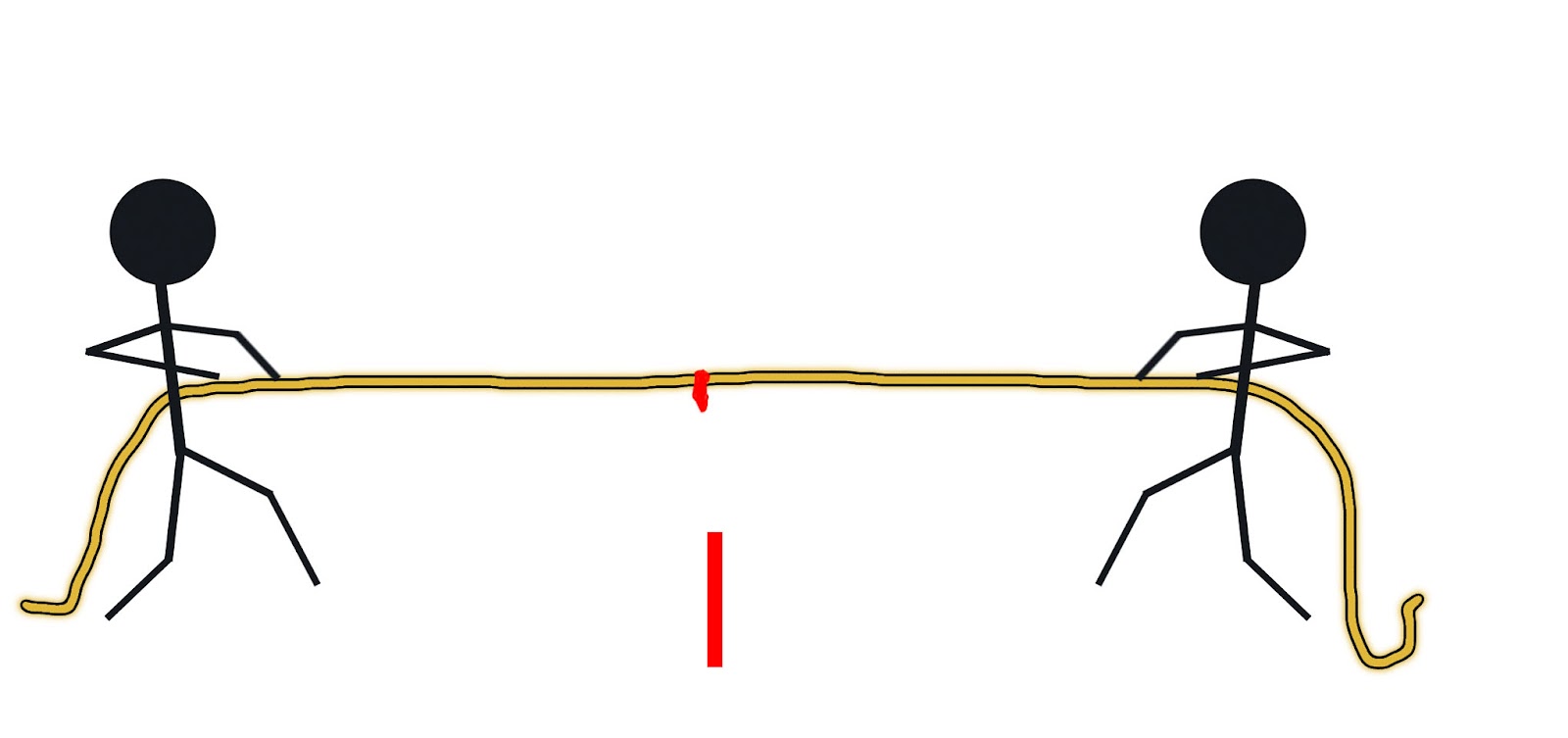
Example: For this example we assume more is better which, by definition, greed is. I would argue that all humans would prefer more of a good thing and less of a bad thing. The best example is a game of tug of war between two people. To measure how well off each person and society (the two players in the game) are in each scenario we will use utility. Utility is an economic term used as a unit of measure for happiness. The higher a person’s utility, the happier they are. Utility is not an exact measurement and is only used for theoretical problems.

Scenario A: If one person has the Greed Block and just takes the very basics of food and shelter they will allow the other person, who follows the natural law of greed, to take more than their fair share. The Greed Block person will be pulled over the line and will be much worse off than the greedy person. The Greed Block person was attempting to be selfless which would help the society of two to become better off. The end result is that the utility of the greedy person is very large and the utility of the Greed Block person is very small. Now this end result is neither good nor bad but logically seems wrong if both parties and their society could have been better off as a whole. A mathematical example of Scenario A would be that the Greed Block person had a utility of 10 while the greedy person had a utility of 90 which would be a total of 100.

Scenario B: If there were two Greed Block people playing tug of war then they would both slightly pull at the rope but realize they were happy as is and would let the rope go limp. The mathematical example of Scenario B would be 10 for each person for a total society utility of 20.

Scenario C: Now if both people in the tug of war were equal and were both greedy people there would be a struggle and a more even distribution of utility. A mathematical example of Scenario C would be 60 on both sides for a total utility of 120.

The mathematical examples of the three scenarios show that a society of greedy people would yield the highest utility. (This has not been proven through research at this point but I would like to conduct research to support this theory. There could be research out there that supports this but I have not found it thus far.) The Greed Block people’s goal was to create a society where we all benefited by not being greedy. Their end goal made society worse off and was not successful since society could have been better off and their goal accomplished if they would have followed the natural law of greed. I view society as a web of ropes that all intersect at the middle. As each person pulls on their end we as a society maximize our personal utility as well as the total utility of the society. I will continue this tug of war example in future writing about the concept of greed. I know not everyone has the same strength in tug of war and in life which will be discussed in future writings.

In conclusion of this section on my Greed series I see a strong connection between Maslow’s Hierarchy and the concept of greed as being a good and a natural law. Maslow’s Hierarchy has different levels of needs for humans which can be viewed as levels of greediness. The more greed each individual has the better off the society will be. Each human should experience all levels of Maslow’s Hierarchy to the fullest extent possible through their greed. Through the theory of the Invisible Hand and my example of a tug of war, greed makes a society better. The goal of an individual should be to maximize the well being of one’s self based on the natural law of greed. Based on greed we should maximize utility to the greatest extent possible. The next paper will be on why laws are required within a society and how government and greed go together hand in hand to create a better society.

Thursday, May 3, 2012

Greed 1.0

Introduction to the Greed Series

     I am going to be exploring the concept of greed by writing a series of blogs and getting feedback from those of you reading as well as from the people around me. Through my recent readings of finance, economics, and the news I have begun to question whether greed is good or bad. Since I am pursuing Financial Engineering and have read many news articles about how bad and greedy Financial Engineers are, I have started to question the society we live in. So please feel free to read the first paper below and give your feedback.

This photo is courtesy of InvestingCaffeine.com

Greed - 1.0

     The word greed has a negative connotation. First we must define greed so that we can discuss the concept of greed. According to Merriam-Webster online dictionary, greed is “a selfish and excessive desire for more of something (as money) than is needed.” That definition is basic and easy to understand at first but the question then becomes what is needed? Is needed food and shelter? Or is it more than that? Is love needed? The question of needs can become controversial and we will therefore assume that it is food and shelter so that we can continue on our exploration of greed. Greed dates back to the biblical times and is condoned by Christians and many other religions as a sin. The question I would like to explore is why is greed bad? Can we all be greedy and be happy? Or is greed bad for a society?